

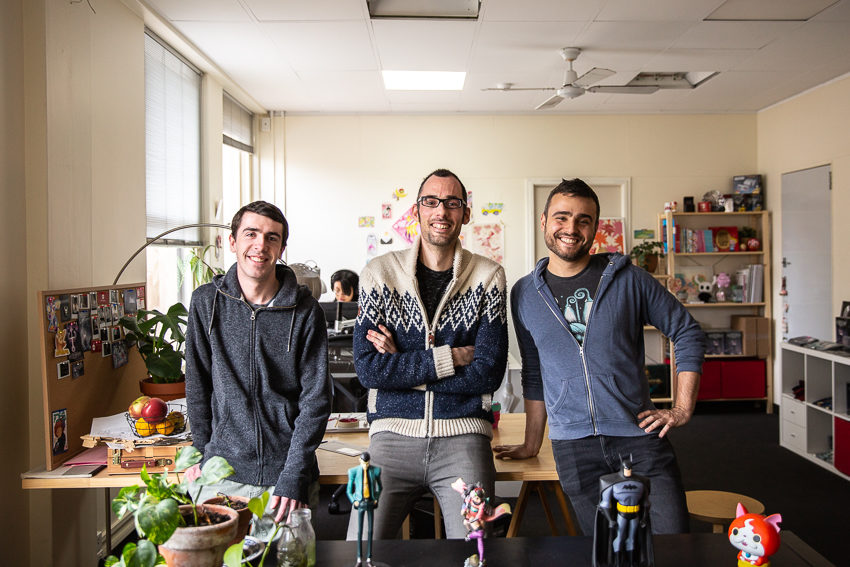

David Kazi, the original programmer, played a crucial role in Hollow Knight’s early development, helping build the game’s foundation and engine. While he later left Team Cherry, his contributions ensured that the game ran smoothly and responsively, allowing for fluid combat and platforming. His technical expertise helped bring Gibson’s art and Pellen’s design to life, making Hollow Knight feel polished and immersive.
Ari Gibson, the team’s co-director and lead artist, was responsible for Hollow Knight’s striking hand-drawn visuals. His background in animation and design gave Hallownest its haunting yet beautiful aesthetic, filled with intricate details and expressive character animations. His work ensured that every area in the game felt distinct and alive, from the eerie, overgrown depths of Greenpath to the decayed, regal architecture of the City of Tears. His visual storytelling helped build Hollow Knight’s atmosphere, making it an unforgettable world to explore.
William Pellen, co-director and lead designer, shaped the game’s core mechanics, level design, and combat system. He ensured Hollow Knight’s platforming and combat felt precise and rewarding, creating challenging yet fair encounters that encouraged mastery. His level design emphasized non-linear exploration, allowing players to discover Hallownest at their own pace. Pellen also designed many of the game’s memorable boss fights, carefully balancing difficulty to make each encounter engaging and satisfying. His work was instrumental in making Hollow Knight one of the best examples of modern Metroidvania gameplay.

Before creating Hollow Knight, Team Cherry participated in game jams, particularly Ludum Dare, a well-known competition where developers create a game in a limited timeframe. This experience helped shape their skills and design philosophy, eventually leading to their breakout success.
One of their earliest projects was Hungry Knight, a small action game developed for Ludum Dare 27 in 2013. This prototype featured a simple white knight character exploring an environment while battling enemies and collecting food to survive. While primitive in comparison to Hollow Knight, it established the foundation for Team Cherry’s artistic style and gameplay ideas, such as stamina-based mechanics and tight combat.
Beyond Hungry Knight, Team Cherry experimented with other small projects and game concepts before fully committing to Hollow Knight. Their participation in Ludum Dare honed their ability to create engaging gameplay loops within short development periods, a skill that would prove invaluable when designing their larger Metroidvania world.
The team’s experience with game jams reinforced their strengths in atmospheric world-building, fluid combat, and hand-drawn animation. With the success of Hollow Knight, they transitioned from small prototypes to a fully realized commercial title, but their early projects, especially Hungry Knight, remain an important part of their development history.
Before Hollow Knight became a critically acclaimed indie success, Team Cherry created a small game called Hungry Knight for Ludum Dare 27 in 2013. This simple action game featured a white, horned knight who had to fight enemies and collect food to prevent starvation. Though rudimentary, Hungry Knight provided the first glimpse into Team Cherry’s artistic style and gameplay philosophy.
In Hungry Knight, players navigated a small world, battling foes while ensuring their character didn’t succumb to hunger. The mechanics were basic but introduced elements of stamina management and combat, themes that would later be refined in Hollow Knight. The game’s aesthetic, with its hand-drawn simplicity, hinted at the beautiful and intricate world-building that Team Cherry would eventually master.
While Hungry Knight was a modest experiment, it was crucial in the team’s journey toward creating Hollow Knight. It gave them experience in game development, helped them refine their artistic approach, and ultimately paved the way for their most successful project. Today, Hungry Knight stands as an early artifact of Team Cherry’s evolution, a small but significant step toward the masterpiece that followed.
In January 2025, Team Cherry, the developers behind the highly anticipated Hollow Knight: Silksong, found themselves at the center of a controversy involving their fanbase. The situation began when co-director William Pellen changed his social media profile picture to an image of a chocolate cake and posted a cryptic message stating, "something big is coming, keep your eyes closed tomorrow." This coincided with the announcement of Nintendo's Switch 2 event, leading fans to speculate that a significant Silksong reveal was imminent. BEEBOM
The fan community, eager for updates after years of limited information, interpreted Pellen's actions as the beginning of an alternate reality game (ARG) or a teaser for upcoming news. However, Matthew Griffin, Team Cherry's marketing and PR director, reached out to prominent Hollow Knight content creator Fireb0rn to clarify the situation. Griffin confirmed that there was no ARG and that the changes to Pellen's account were a "nothingburger." He further reassured fans by stating, "Yes, the game is real, progressing and will release." GAMESRADAR
This incident sparked frustration and disappointment within the Hollow Knight community. Many fans felt misled by the perceived tease, especially given the prolonged silence regarding Silksong's development. The episode highlighted the challenges developers face in managing fan expectations and the potential consequences of miscommunication, even unintentional, in a highly engaged community.
For a more detailed discussion on this topic, you might find the following video insightful: